

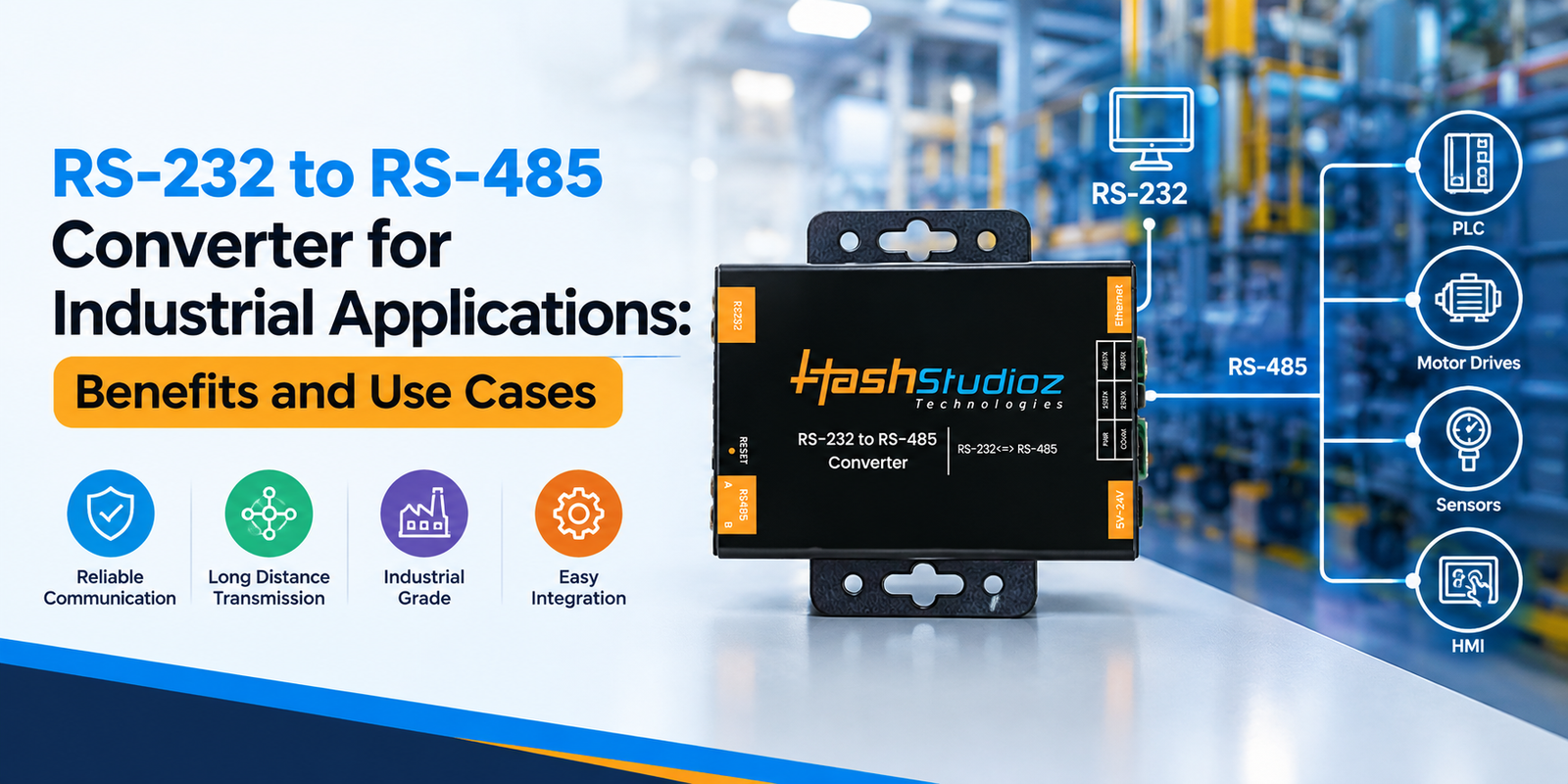
RS-232 to RS-485 Converter for Industrial Applications: Benefits and Use Cases
Industrial automation systems often include machines, sensors, controllers, meters, PLCs, and other devices that use different communication interfaces. RS-232 and RS-485 are two widely used serial communication standards, but they have different capabilities and are designed for different applications.
An RS-232 to RS-485 converter provides a practical way to connect RS-232 devices with RS-485-based industrial networks. It allows existing equipment to communicate with modern industrial systems without requiring a complete replacement of legacy devices.
In this article, we will explore how RS-232 to RS-485 converters work, their key benefits, and their common industrial use cases.
What Is an RS-232 to RS-485 Converter?
An RS-232 to RS-485 converter is a communication device that converts electrical signals between the RS-232 and RS-485 interfaces.
RS-232 is commonly used for short-distance, point-to-point communication between two devices. RS-485, on the other hand, is designed for longer-distance communication and supports multiple devices on the same bus.
The converter acts as a bridge between these two communication standards.
For example, an industrial computer or controller with an RS-232 port can communicate with multiple RS-485 devices through a converter.
Basic communication flow:
RS-232 Device → RS-232/RS-485 Converter → RS-485 Network → Industrial Devices
This makes the converter useful for integrating older serial equipment with newer industrial automation and monitoring systems.
RS-232 vs. RS-485: What Is the Difference?
Understanding the differences between RS-232 and RS-485 helps explain why conversion is often required in industrial environments.
| Feature | RS-232 | RS-485 |
| Communication type | Point-to-point | Multi-device bus |
| Typical distance | Short | Longer distance |
| Number of devices | Usually 2 | Multiple devices |
| Signal type | Single-ended | Differential |
| Noise immunity | Lower | Higher |
| Industrial suitability | Limited | High |
| Common applications | PCs, legacy equipment | PLCs, sensors, meters, automation |
RS-485 is generally better suited to industrial environments because its differential signaling provides better resistance to electrical noise and allows communication over longer cable distances.
However, many existing machines and controllers still use RS-232. An RS-232 to RS-485 converter helps bridge this compatibility gap.
How Does an RS-232 to RS-485 Converter Work?
The converter receives serial data from the RS-232 interface, processes the electrical signals, and transmits the corresponding data through the RS-485 interface.
The process works in both directions:
RS-232 → RS-485
Data from an RS-232 device is converted into an RS-485 signal and transmitted to the connected RS-485 network.
RS-485 → RS-232
Data received from the RS-485 network is converted into an RS-232 signal for the connected RS-232 device.
The conversion is generally transparent to the application. This means devices can continue using their existing serial communication protocols while the converter handles the physical-layer signal conversion.
Key Benefits of RS-232 to RS-485 Converters
1. Connect Legacy Equipment to Modern Networks
Many industrial facilities continue to operate equipment that was installed years ago. Replacing functional machines simply because they use RS-232 can be expensive.
A converter allows legacy RS-232 equipment to communicate with RS-485 networks, extending the useful life of existing machinery.
2. Supports Longer Communication Distances
RS-232 is typically intended for shorter communication distances. RS-485 is better suited for longer industrial communication links.
Using a converter makes it possible to connect an RS-232 device to an RS-485 network where greater cable distance is required.
The actual achievable distance depends on factors such as baud rate, cable quality, network topology, and installation conditions.
3. Better Noise Resistance
Industrial environments can contain electrical noise generated by motors, drives, relays, switching power supplies, and other equipment.
RS-485 uses differential signaling, which provides better immunity to common-mode electrical interference compared with RS-232.
This makes RS-232 to RS-485 conversion useful for industrial environments where reliable serial communication is important.
4. Enables Multi-Device Communication
RS-232 is generally designed for communication between two devices.
RS-485 can support multiple devices on a shared communication bus, depending on the transceiver and network implementation.
This allows a single RS-232 controller or computer to communicate with multiple industrial devices through an RS-485 network.
5. Cost-Effective System Upgrades
Industrial organizations often want to modernize their communication infrastructure without replacing all existing equipment.
An RS-232 to RS-485 converter offers a relatively simple way to integrate legacy devices into newer systems.
This can reduce hardware replacement costs and minimize downtime during system upgrades.
6. Flexible Industrial Integration
RS-232 and RS-485 are used with many industrial protocols and devices. Depending on the application, converters can be used as part of systems communicating through protocols such as Modbus RTU.
The converter itself generally handles the electrical interface conversion rather than changing the higher-level communication protocol.
Common Industrial Applications
1. PLC Communication
Programmable Logic Controllers (PLCs) are widely used for controlling industrial machinery and production processes.
When a PLC or industrial controller uses RS-232 while field devices use RS-485, a converter can provide the required communication interface between them.
This can be useful for connecting:
- PLCs
- HMIs
- Industrial PCs
- Remote I/O modules
- Sensors
- Controllers
2. Industrial Automation
Automation systems often combine equipment from different manufacturers. Not every device necessarily uses the same communication interface.
An RS-232 to RS-485 converter helps integrate equipment with different serial interfaces into a common communication infrastructure.
This is particularly useful in manufacturing plants, process automation systems, and machine-control environments.
3. Energy Meters and Power Monitoring
Energy meters and power-monitoring equipment commonly use serial communication for transferring measurement data.
An RS-232-enabled monitoring computer can communicate with RS-485-based meters through a converter.
This can support applications such as:
- Energy monitoring
- Power consumption tracking
- Industrial dashboards
- Remote meter reading
- Utility monitoring
4. Industrial Sensors and Data Acquisition
Industrial sensors, controllers, and data acquisition systems may use RS-485 because of its suitability for longer cable runs.
A converter can connect these devices to an RS-232-based computer or control system for collecting and processing data.
5. Building and Facility Automation
RS-485 is commonly used in building automation and control systems.
Applications may include:
- HVAC monitoring
- Temperature controllers
- Access control systems
- Lighting control
- Environmental monitoring
An RS-232 to RS-485 converter can help connect these systems with computers or legacy control equipment.
6. Factory Monitoring Systems
Manufacturing facilities often need to collect information from machines distributed across production areas.
An RS-232 to RS-485 converter can help connect legacy serial equipment to an RS-485 communication network, allowing production data to be collected by a central monitoring system.
7. Modbus RTU Networks
Modbus RTU is widely used in industrial automation and typically operates over RS-485.
If an existing controller or computer provides an RS-232 interface, an RS-232 to RS-485 converter can provide the physical connection required to communicate with Modbus RTU devices.
The converter does not necessarily convert Modbus RTU into another protocol; instead, it converts the electrical interface while the communication protocol remains unchanged.
Important Features to Consider
Choosing the right RS-232 to RS-485 converter depends on the application and installation environment.
Baud Rate
The converter should support the communication speed required by the connected devices, such as 9600, 19200, 38400, 57600, or higher rates where supported.
Isolation
For industrial applications, electrical isolation can help protect equipment from ground potential differences and electrical disturbances.
An isolated converter may be preferable for installations with long cable runs or electrically noisy environments.
ESD and Surge Protection
Industrial communication interfaces can be exposed to electrostatic discharge and transient electrical events.
Converters with appropriate protection features can improve system reliability.
Power Supply
Check the required input voltage and ensure it matches the available industrial power source.
Converters designed for industrial use may support a wider DC input range.
Connector Type
Depending on the installation, the converter may use screw terminals, DB9 connectors, terminal blocks, or other interfaces.
Select a connector arrangement that fits the existing equipment and wiring.
Operating Temperature
For factory floors, control cabinets, outdoor installations, or other demanding environments, check the converter’s operating temperature range.
Communication Mode
The converter should support the required RS-485 configuration, including half-duplex or full-duplex communication where applicable.
RS-232 to RS-485 Converter vs. USB to RS-485 Converter
These two devices serve different purposes.
An RS-232 to RS-485 converter is useful when an existing device already has an RS-232 serial port and needs to communicate with an RS-485 network.
A USB to RS-485 converter, on the other hand, is generally used when a computer or industrial PC needs to communicate directly with an RS-485 device through USB.
The right option depends on the interfaces available on the equipment.
Tips for Reliable RS-485 Communication
A converter alone does not guarantee reliable communication. Proper network installation is also important.
Consider the following practices:
- Use suitable twisted-pair cable for RS-485 communication.
- Follow the recommended bus topology.
- Avoid unnecessary long stubs.
- Use termination where required by the network design.
- Maintain appropriate signal grounding and shielding.
- Keep communication cables away from high-power electrical wiring where possible.
- Select a suitable baud rate for the cable distance and environment.
- Check device addressing when using multi-device networks.
- Verify that all connected devices use compatible communication settings.
Proper installation can significantly improve communication reliability in industrial environments.
Why Use RS-232 to RS-485 Conversion in Industrial IoT?
Industrial IoT systems often require data from both new and legacy equipment.
Replacing every legacy device can be expensive and disruptive. Instead, interface converters can help bring older equipment into a connected architecture.
For example:
Legacy Machine → RS-232 → Converter → RS-485 → IoT Gateway → Cloud Platform
This approach can allow existing machines to continue operating while their data becomes available to modern monitoring, analytics, and IoT platforms.
It can be especially useful when organizations are gradually upgrading their industrial infrastructure rather than performing a complete system replacement.
Conclusion
An RS-232 to RS-485 converter provides a simple and cost-effective way to connect legacy RS-232 equipment with RS-485 industrial networks.
Its ability to support longer communication distances, multi-device networks, and better noise resistance makes RS-485 a practical choice for industrial environments. With the right converter, organizations can integrate existing machines, controllers, meters, and other serial devices into modern automation and Industrial IoT systems.
Whether the goal is to upgrade a factory network, connect legacy equipment, build a Modbus RTU system, or collect machine data for an IoT platform, an RS-232 to RS-485 converter can play an important role in creating a reliable and scalable communication infrastructure.
